
Verify identity at the edge. Store zero raw PII.
Traditional identity stacks pull sensitive biometrics and passport scans into vulnerable cloud vaults. FlippedStack flips the architecture—executing facial biometrics, passive liveness, document KYC, and age assurance locally on the user’s device.
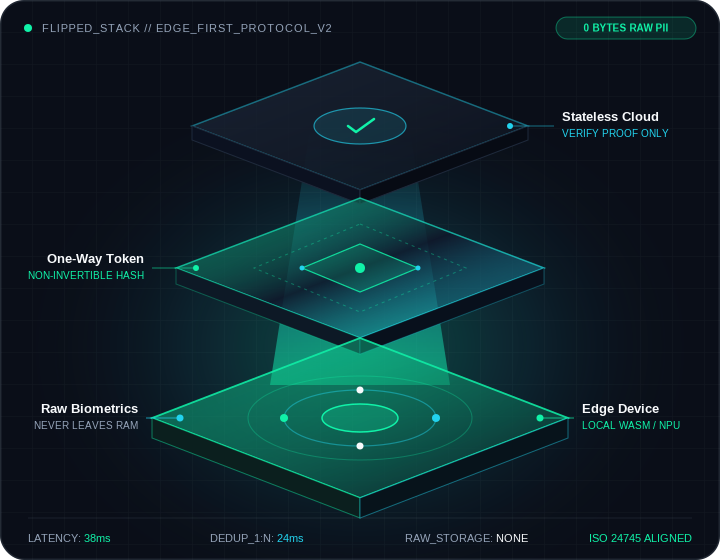
Why We Flipped the Stack
You can’t leak biometric data you never collect.
Centralized identity databases turn compliance into a permanent security liability. Moving cryptographic verification to the endpoint removes the breach target entirely.
Raw PII pulled up into centralized servers
- ✕ Uploads raw selfie videos and government ID photos across networks into cloud buckets.
- ✕ Stores reconstructible biometric templates—creating catastrophic GDPR, BIPA, and DPDP risk.
- ✕ Heavy server-side GPU inference adds network round-trips, high per-check costs, and latency spikes.
- ✕ Active head-turn challenges frustrate real users while still missing modern injection attacks.
Cryptographic verification pushed down to the device
- ✓ Facial extraction, passive liveness, and ID OCR run strictly in local device memory (WASM / NPU).
- ✓ Emits only mathematically irreversible, cancelable tokens and signed boolean assertions.
- ✓ Sub-50ms local authentication and ~25ms constant-time 1:N deduplication at planet scale.
- ✓ 100% passive liveness and deepfake defense with single-glance UX and high conversion rates.
Modular Identity Suite
Every trust primitive—rebuilt without a PII database.
Zero-Vault Biometric Auth
Replace passwords and SMS OTPs with FIDO2/WebAuthn passkeys bound to sub-50ms on-device facial proof and irreversible deduplication.
Edge KYC & Document Proof
Automated government ID OCR, document authenticity forensics, and portrait-to-ID comparison executed directly in the client runtime.
Anonymous Age Assurance
Meet global child-safety and age-gating mandates in under a second with on-device age estimation and zero identity collection.
Passive Liveness & Deepfake Shield
Stop injection attacks, printed masks, screen replays, and generative AI deepfakes with frictionless passive liveness at the edge.
Reusable Cryptographic Credentials
Issue W3C-aligned verifiable credentials to user-held wallets so customers verify once and prove attributes everywhere privately.
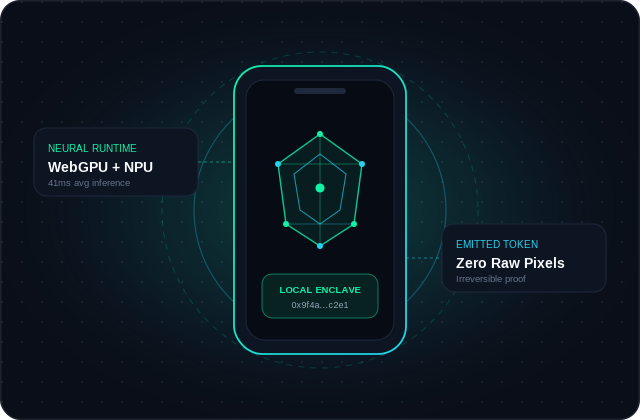
On-Device Cryptographic Enclave
Passwordless biometric login with mathematical privacy.
Bind human presence directly to FIDO2/WebAuthn passkeys. FlippedStack extracts facial features inside the device’s ephemeral memory, projects them into an irreversible token, and wipes the raw frame immediately.
- Eliminates SIM-swap, credential stuffing, and phishing attacks
- Constant-time 1:N deduplication stops multi-account promo abuse & bots
- Account recovery in seconds—even when a user loses their phone
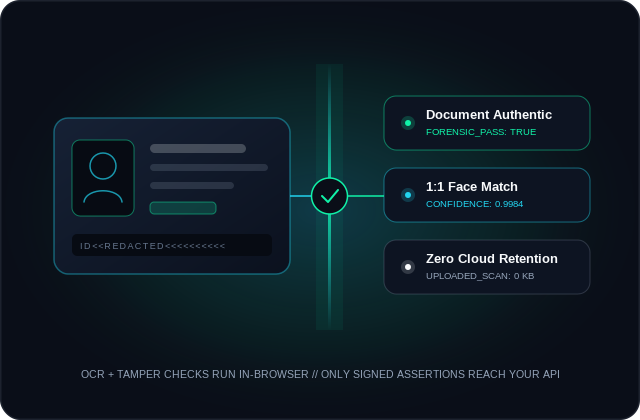
Zero-Storage Document Proof
Complete KYC and age verification without stockpiling passports.
Run front-and-back ID capture, MRZ parsing, forensic tamper analysis, and 1:1 selfie comparison entirely on
the user’s device. Your backend receives only cryptographically signed assertions—such as
age_over_18: true
or verified country eligibility.
- Supports global passports, national IDs, and driver’s licenses (190+ countries)
- Anonymous Age Assurance verifies eligibility in under 250 ms with zero login
- Issue reusable W3C verifiable credentials for instant 1-tap re-verification
Regulatory Alignment
Engineered for global privacy laws from line one.
Privacy by Architecture
By eliminating centralized raw biometric storage, FlippedStack dramatically narrows your data-controller liability across the EU GDPR and India DPDP Act.
Zero Biometric Vaults
Raw facial geometry never leaves the endpoint device and cannot be reconstructed from our irreversible cryptographic tokens.
Irreversible Tokenization
Engineered around biometric template protection principles—cancelable, unlinkable, and mathematically non-invertible across applications.
Enterprise Assurance
Supports high-assurance IAL2 identity proofing and phishing-resistant AAL2/AAL3 cryptographic authentication workflows.
Built for Engineering Teams
Drop-in edge SDKs. Integrate in an afternoon.
Ship native-speed biometric verification in WebAssembly, Swift, and Kotlin with stateless server-side verification. No GPU clusters to provision, no PII storage buckets to audit.
import { FlippedStack } from '@flippedstack/edge-sdk';

// Initialize local WebAssembly + WebGPU enclave (0 raw uploads)
const fs = await FlippedStack.init({
  appKey: process.env.NEXT_PUBLIC_FLIPPEDSTACK_KEY,
  mode: 'on-device-strict',
});

// Run passive liveness + one-way biometric tokenization locally
const proof = await fs.verifyBiometric({
  cameraElement: videoEl,
  liveness: 'passive',
  deduplicate: true,
});

// Only an irreversible cryptographic token leaves the browser
console.log(proof.tokenHash);       // "fs_tok_9f4a81...c2e1"
console.log(proof.rawBytesSent);    // 0
console.log(proof.latencyMs); // 39import FlippedStackEdge
let engine = try FlippedStackEngine(
appId: "fs_live_9921",
enclaveBinding: .secureEnclave
)
// On-device passive liveness + anonymous age check (< 200ms)
let assertion = try await engine.assureAge(
minimumAge: 18,
requirePassiveLiveness: true
)
// Signed zero-knowledge assertion — zero face images retained
if assertion.meetsThreshold {
try await api.submitSignedProof(assertion.jwsToken)
}import com.flippedstack.edge.FlippedStackClient
import com.flippedstack.edge.KycPolicy
val client = FlippedStackClient.builder(context)
.useHardwareKeystore(true)
.zeroCloudRetention(true)
.build()
// Local document OCR, tamper check & 1:1 selfie comparison
val result = client.verifyDocumentAndSelfie(
policy = KycPolicy.NIST_IAL2,
discloseAttributes = listOf("over_18", "country_iso")
)
// Receive cryptographically signed verdict without ID image files
api.completeOnboarding(result.signedAttestation)import { verifyAttestation } from '@flippedstack/server';
export async function POST(req: Request) {
const { signedAttestation, tokenHash } = await req.json();
// Stateless cryptographic signature + constant-time 1:N check
const verdict = await verifyAttestation({
attestation: signedAttestation,
dedupGallery: 'production-users',
tokenHash,
});
return Response.json({
verified: verdict.valid,
isDuplicateAccount: verdict.duplicateDetected,
piiStored: false,
});
}Technical FAQ
Common architecture & privacy questions
How is FlippedStack different from traditional cloud identity verification vendors? +
Traditional vendors upload raw selfie videos, passport scans, and facial templates to centralized cloud servers—creating massive data-breach targets and compliance burdens. FlippedStack flips the architecture: biometric extraction, liveness checks, OCR, and matching run locally on the user’s device, emitting only irreversible cryptographic proofs.
Can anyone reverse-engineer a user’s face or personal data from a FlippedStack token? +
No. Our cryptographic tokenization transforms local biometric features through a one-way, application-scoped mathematical projection. Neither FlippedStack nor your backend ever receives a raw image or reconstructible biometric template.
How does 1:N duplicate account detection work without storing raw biometrics? +
During enrollment, the edge runtime derives an anonymized, irreversible verification token locally. Your server (or our stateless matcher) compares encrypted token geometry in constant time (~25 ms) to flag duplicate accounts without ever knowing what the user looks like.
Which platforms and browsers do FlippedStack SDKs support? +
We provide lightweight client runtimes for Web (WebAssembly + WebGPU across Chrome, Safari, Firefox, and Edge), native iOS (Swift), and native Android (Kotlin), paired with stateless verification SDKs for Node.js, Python, and Go.
Can FlippedStack deploy inside our own VPC or air-gapped environment? +
Yes. Because client-side processing eliminates heavy GPU cloud inference, the lightweight server verification layer can run in our managed multi-region edge cloud or inside your own AWS, GCP, Azure, or on-premise Kubernetes cluster.
Ready to Flip Your Stack?
Eliminate biometric liability today.
Schedule a technical walkthrough with our engineering team or request sandbox keys to test on-device verification in your own browser or mobile app.